
Cancel Culture: Accountability or Online Bullying?
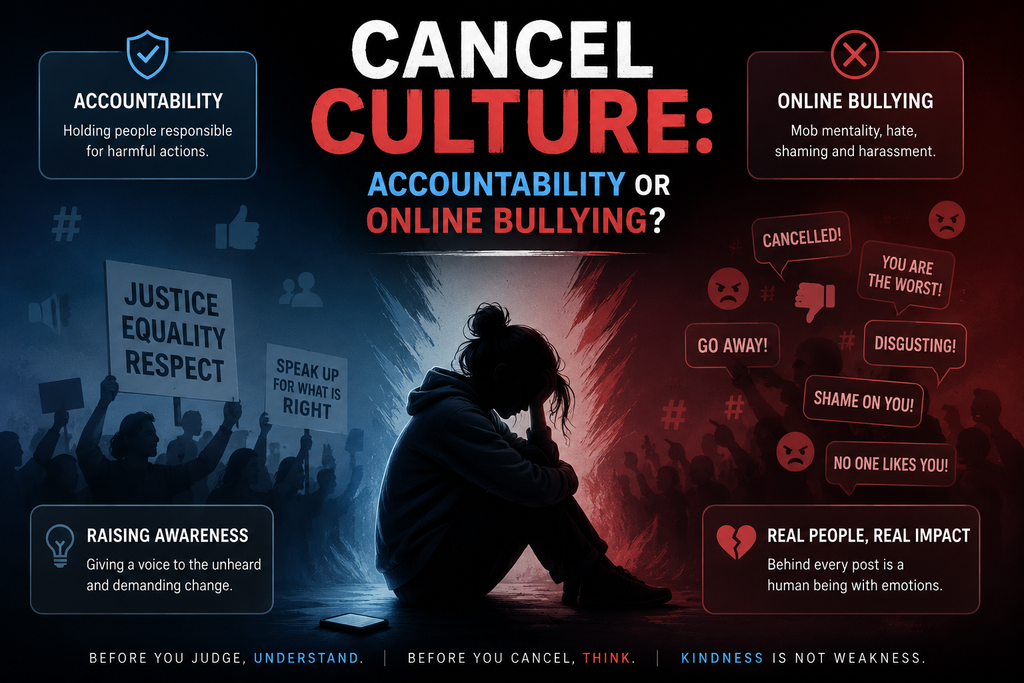
Cancel Culture: Accountability or Online Bullying?
Introduction
In today’s digital world, social media has become a powerful platform for communication, entertainment, activism, and public discussion. Along with these benefits, a new social phenomenon called “cancel culture” has become increasingly common. Cancel culture refers to the practice of publicly calling out, criticizing, boycotting, or withdrawing support from a person, brand, organization, or public figure because of something they have said or done that is considered offensive, harmful, or unacceptable.
Cancel culture can sometimes serve an important purpose by holding powerful people and organizations accountable. However, it can also become a form of online bullying, where people are attacked, humiliated, threatened, or permanently judged without proper understanding of the situation. This creates an important question: Is cancel culture a form of accountability, or has it become another form of online bullying?
What Is Cancel Culture?
Cancel culture is mainly associated with social media platforms such as Instagram, X, Facebook, TikTok, YouTube, and other online communities. When someone makes a controversial statement or is accused of inappropriate behavior, users may share screenshots, videos, posts, or information about the incident.
If the issue becomes widely discussed, thousands or even millions of people may join the conversation. They may demand an apology, ask others to stop supporting the person, or encourage companies to end partnerships with them.
For example, if a celebrity promotes something harmful or makes a discriminatory statement, people may criticize them online and decide not to watch their movies or purchase products associated with them. In this situation, cancel culture can function as a form of consumer and social pressure.
Cancel Culture as Accountability
One of the strongest arguments in favor of cancel culture is that it can create accountability.
In the past, powerful individuals and organizations could sometimes avoid consequences for harmful actions because ordinary people had limited ways to make their voices heard. Social media has changed this situation. Today, people can quickly share information and bring attention to issues that might otherwise remain unnoticed.
Cancel culture can therefore give a voice to victims and marginalized communities. When many people speak together, organizations may be encouraged to investigate complaints, correct mistakes, or change harmful policies.
For example, public criticism has sometimes encouraged companies to apologize for offensive advertisements, improve workplace practices, or reconsider controversial decisions. Similarly, public figures who make harmful comments may be encouraged to acknowledge their mistakes and learn from them.
Accountability is important in any society. People should understand that freedom of speech does not mean freedom from all consequences. If someone causes genuine harm, reasonable criticism and consequences can be appropriate.
When Accountability Becomes Online Bullying
However, cancel culture becomes problematic when criticism turns into harassment, threats, humiliation, or abuse.
Social media encourages people to react quickly. A controversial post can spread within minutes, while the full context may not be known. Sometimes an old statement is taken out of context or information is shared without checking whether it is true.
Once thousands of people become angry, the target can experience overwhelming online abuse. Their personal information may be exposed, their family members may be contacted, and they may receive threats or hateful messages. This goes far beyond reasonable accountability.
Online bullying can have serious emotional and psychological consequences. A person who becomes the target of a viral controversy may experience fear, stress, embarrassment, isolation, and damage to their personal or professional reputation.
Another problem is that social media users often act as judge and jury at the same time. People may decide that someone is guilty based only on a short video, screenshot, or headline. There may be little opportunity for the accused person to explain the situation.
The Problem of “Trial by Social Media”
One major concern surrounding cancel culture is the idea of “trial by social media.”
Traditional systems of justice generally require evidence, investigation, and an opportunity for people to defend themselves. Social media does not always follow these principles. A person can become the target of millions of users before all the facts are known.
Sometimes accusations turn out to be incomplete, exaggerated, or false. Even when a mistake is corrected later, the original information may have already reached millions of people. The damage to someone’s reputation may therefore continue.
This demonstrates why people should be careful before sharing accusations online. Viral does not necessarily mean true.
The Role of Social Media Users
Social media users have an important responsibility when participating in controversial discussions.
Before reposting or commenting on an accusation, people should ask:
Is the information reliable?
Do I know the complete context?
Is the source trustworthy?
Am I criticizing an action or attacking a person?
Am I contributing to accountability or simply joining an online mob?
Does my comment encourage discussion, or does it encourage harassment?
These questions can help create a healthier online environment.
People should also understand the difference between criticism and harassment. Saying, “I disagree with this statement and will no longer support this person,” is different from sending abusive messages or encouraging thousands of people to attack them.
Can People Change?
Another important question is whether cancel culture allows people to learn from their mistakes.
Human beings make mistakes. Some actions are serious and may require significant consequences. However, not every mistake should automatically result in permanent social rejection.
There should be room for genuine apologies, education, personal growth, and rehabilitation when appropriate. If someone recognizes their mistake, takes responsibility, apologizes sincerely, and changes their behavior, society should consider whether continuing to punish them serves any useful purpose.
At the same time, an apology should not be used as a way to escape responsibility. Genuine accountability requires more than simply saying “sorry.” It may involve correcting the harm, changing behavior, accepting reasonable consequences, and demonstrating improvement over time.
Finding a Balance
The solution is not to completely support or completely reject cancel culture. Instead, society needs to find a balance between accountability and compassion.
Accountability means recognizing harmful behavior and ensuring that appropriate consequences exist. Online bullying involves attacking, humiliating, threatening, or dehumanizing someone.
A responsible approach would involve:
Checking facts before reacting.
Understanding the full context.
Criticizing behavior rather than someone’s entire identity.
Avoiding threats and personal attacks.
Allowing reasonable opportunities for explanation.
Supporting victims without encouraging harassment.
Recognizing genuine apologies and positive change.
Holding powerful organizations accountable through peaceful and lawful methods.
Social media can be a powerful tool for positive change when used responsibly.
Conclusion
Cancel culture is neither completely good nor completely bad. It can be a powerful mechanism for accountability, especially when it exposes genuine wrongdoing and gives victims a voice. However, when public criticism becomes harassment, threats, humiliation, or punishment without evidence, it crosses the line into online bullying.
The real challenge is learning how to hold people accountable without destroying them. Social media users should remember that behind every account is a real human being with emotions, relationships, and a life beyond the internet.
Instead of immediately joining an online mob, people should pause, verify information, understand the context, and respond responsibly. Accountability should aim to correct harmful behavior, not simply punish people for the sake of punishment.
Ultimately, a healthier digital society is one where people can speak against injustice while also respecting fairness, evidence, empathy, and the possibility of change. The goal should not be to “cancel” people, but to encourage a culture where responsibility, learning, and positive change are possible.