
Digital distraction — difficulty focusing because of constant notifications and apps.
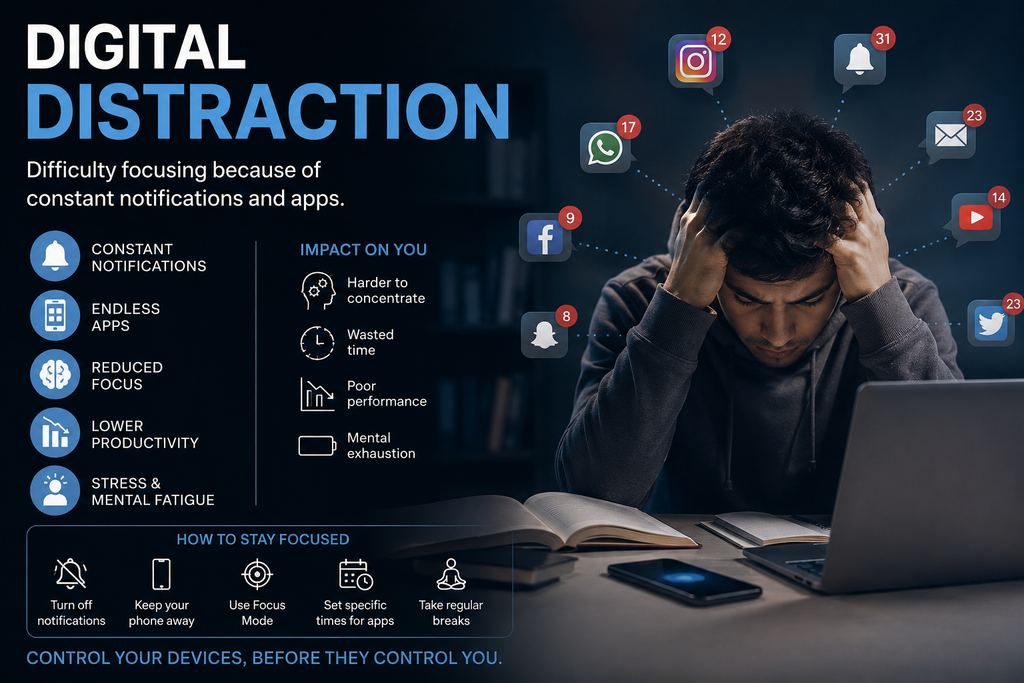
In today’s modern world, digital devices have become an important part of our everyday lives. Smartphones, laptops, tablets, smartwatches, and other digital technologies help us communicate, study, work, shop, entertain ourselves, and stay connected with the world. However, the same technology that makes our lives easier can also create a serious problem called digital distraction.
Digital distraction refers to the difficulty of concentrating on an important task because of constant notifications, social media, messages, apps, videos, games, and other digital content. A person may sit down to study for an hour, but after receiving a notification, they check their phone. One notification can lead to opening Instagram, watching reels, replying to messages, and scrolling through other content. As a result, a task that should take one hour may take much longer.
Digital distraction is especially common among students and young people because smartphones and social media are deeply connected to their daily routines. Understanding its causes, effects, and solutions is important for maintaining concentration, productivity, and mental well-being.
What Is Digital Distraction?
Digital distraction occurs when digital devices or online activities interrupt a person’s attention. These interruptions can be intentional or unintentional.
For example, while doing an assignment, a student may hear a notification sound. Even if the student does not immediately open the notification, their mind may start wondering who sent the message. This small interruption can affect concentration.
Digital distraction does not always mean spending many hours on a phone. Even frequent checking of notifications for a few seconds can interrupt the flow of concentration. When this happens repeatedly throughout the day, it can significantly reduce productivity.
Common examples of digital distractions include:
- Social media notifications
- WhatsApp and other messaging apps
- Instagram Reels and YouTube Shorts
- Online games
- Emails
- Pop-up notifications
- Phone calls
- Streaming platforms
- News alerts
- Unnecessary browsing
- Constantly checking likes, comments, and messages
Major Causes of Digital Distraction
1. Constant Notifications
Notifications are one of the biggest causes of digital distraction. Smartphones continuously provide alerts about messages, emails, social media activity, updates, and advertisements.
A person may be studying or working peacefully when a notification suddenly appears. The natural reaction is often to check it immediately. This interrupts the current activity and shifts attention toward the phone.
2. Social Media
Social media platforms are designed to keep users engaged. Instagram, Facebook, TikTok, YouTube, and similar platforms provide an endless flow of content.
Short-form videos are particularly distracting because they are easy to watch and require very little effort. A person may open an app intending to watch one video but continue scrolling for a long time.
3. Fear of Missing Out
Another important reason is FOMO, or the fear of missing out. People may feel that they need to check their phones frequently because they are afraid of missing an important message, trend, update, or social event.
This creates a habit of checking notifications even when there is no urgent reason to do so.
4. Multitasking
Many people believe they can use their phones while studying or working without affecting their performance. However, switching between different activities can make it harder to maintain attention.
For example, a student may study for five minutes, check Instagram, return to studying, reply to WhatsApp, and then watch a YouTube video. Although the person feels busy, very little focused work may actually be completed.
5. Habit
Checking the phone can become an automatic habit. Some people unlock their phones whenever they feel bored, uncomfortable, or have nothing to do.
Over time, this repeated behavior can make it difficult to spend even a short period without digital stimulation.
Effects of Digital Distraction
1. Reduced Concentration
The most obvious effect of digital distraction is reduced concentration. When attention constantly moves between different apps and activities, it becomes difficult to focus deeply on one task.
Students may read the same paragraph several times because their attention keeps moving toward their phones.
2. Lower Productivity
Digital distraction can significantly reduce productivity. A task that could be completed in 30 minutes may take an hour because of repeated interruptions.
Instead of completing important work, people may spend large amounts of time checking notifications and browsing social media.
3. Poor Academic Performance
For students, digital distraction can affect learning. Constant phone usage while studying can make it difficult to understand and remember information.
Students may spend more time studying but achieve less because their study sessions are frequently interrupted.
4. Stress and Mental Fatigue
Constant notifications can make the brain feel as though it must always respond to something. This can create mental pressure.
When people constantly move between messages, videos, assignments, and social media, they may feel mentally tired even if they have not done much physical work.
5. Sleep Problems
Using smartphones late at night can also affect sleep routines. Many people intend to check their phones for a few minutes before sleeping but end up scrolling for much longer.
Late-night digital activity can delay bedtime and reduce the amount of time available for proper rest.
6. Reduced Face-to-Face Communication
Digital distraction can also affect relationships. For example, a person may be having a conversation with a friend or family member while repeatedly checking their phone.
This can make the other person feel ignored and can reduce the quality of real-life communication.
Digital Distraction Among Students
Students are one of the groups most affected by digital distraction. Smartphones provide many useful educational resources, but they also provide unlimited entertainment.
A student can use a phone to attend an online class, search for information, read an e-book, or watch an educational video. At the same time, the same device provides access to games, social media, entertainment, and messaging apps.
Therefore, the problem is not necessarily the existence of technology. The real challenge is how technology is used.
For example, a student preparing for an examination may keep their phone next to them while studying. Every notification creates an opportunity to stop studying. Even when notifications are not opened, the expectation of receiving them can reduce concentration.
Developing healthy digital habits is therefore very important for students.
How to Reduce Digital Distraction
1. Turn Off Unnecessary Notifications
One of the easiest solutions is to disable notifications that are not important. Social media notifications, promotional messages, and unnecessary app alerts can be turned off.
Keeping only essential notifications can create a quieter digital environment.
2. Use Focus Mode
Most smartphones provide features such as Focus Mode, Do Not Disturb, or app limits. These tools can prevent unnecessary notifications during study or work sessions.
For example, a student can activate Focus Mode for one hour while studying.
3. Keep the Phone Away
Keeping the phone physically away from the study table or workplace can be very effective. If the phone is not easily accessible, there is less temptation to check it.
Even placing the phone in another room or inside a bag can help improve concentration.
4. Set Specific Social Media Times
Instead of checking social media throughout the day, users can set specific periods for it.
For example:
- 20 minutes in the afternoon
- 20 minutes in the evening
This makes social media a planned activity instead of a constant interruption.
5. Follow the 25-Minute Focus Method
A simple technique is to work for 25 minutes without digital distractions, followed by a short break.
During those 25 minutes, the phone can be kept away and notifications can remain off. After completing the focused session, a short break can be taken.
6. Avoid Phone Use Before Sleeping
Creating a phone-free period before bedtime can help establish a healthier night routine. Instead of scrolling through social media, people can read a book, listen to calm music, prepare for the next day, or simply relax.
7. Create a Digital-Free Environment
Families, schools, and workplaces can encourage digital-free periods. For example, meals can become phone-free times.
This can improve communication and help people become more comfortable spending time without digital devices.
The Positive Side of Technology
It is important to understand that technology itself is not the enemy. Digital devices provide many benefits.
Students can access online courses, educational videos, digital libraries, and learning applications. Professionals can communicate with colleagues from different countries. Social media can help creators share their work and businesses reach customers.
The goal is not to completely avoid technology. Instead, the goal is to use technology intentionally rather than allowing technology to control our attention.
A smartphone should be a useful tool, not something that controls every moment of the day.
Conclusion
Digital distraction has become a major challenge in modern life. Constant notifications, social media, short videos, messaging apps, games, and online entertainment can make it difficult to maintain attention. Although each interruption may seem small, repeated interruptions can have a significant impact on concentration, productivity, studies, relationships, sleep, and mental well-being.
The solution is not to completely reject technology. Instead, people should develop healthy digital habits. Turning off unnecessary notifications, using Focus Mode, keeping phones away during important tasks, limiting social media time, and creating phone-free periods can help reduce digital distraction.
Ultimately, our attention is one of our most valuable resources. Learning to control when and how we use digital devices allows us to study better, work more effectively, communicate more meaningfully, and enjoy our offline lives. Technology should support our lives—not constantly interrupt them.