
Fake News on Social Media: Why Do People Believe It? heading
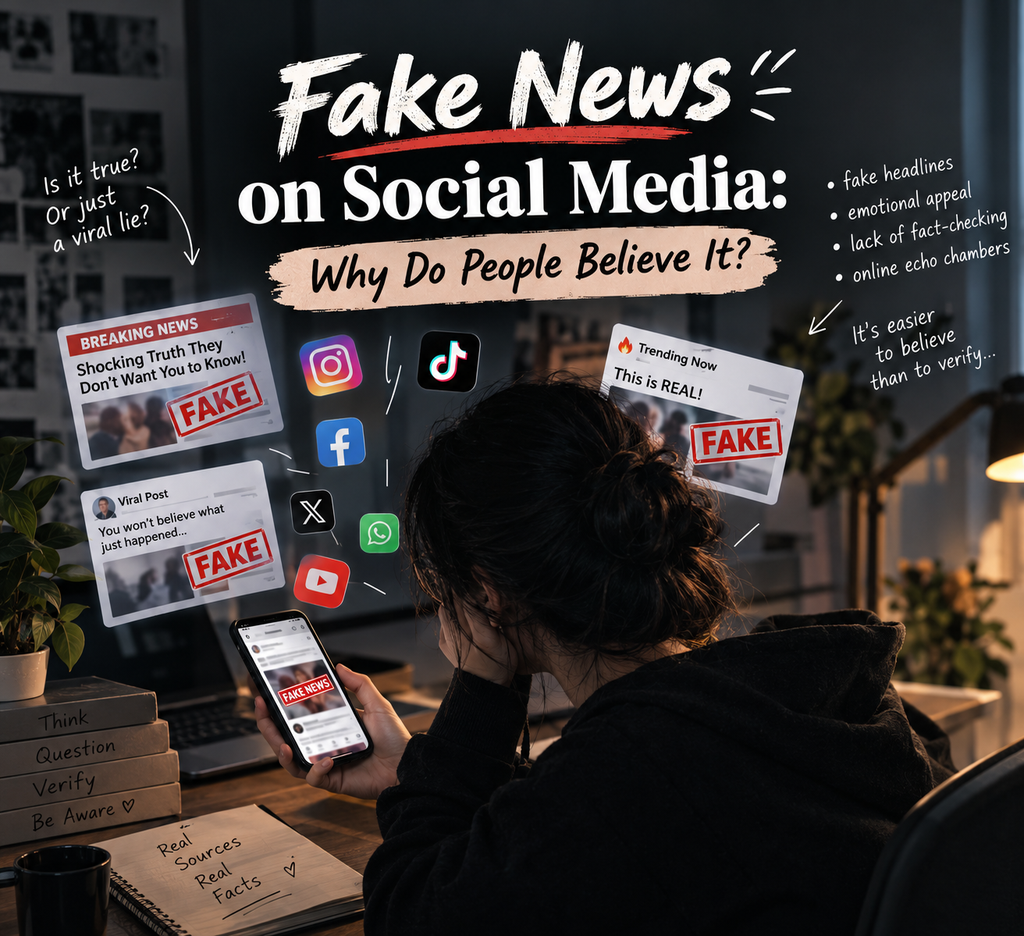
Fake News on Social Media: Why Do People Believe It?
Social media has become one of the most powerful sources of information in modern society. Platforms such as Instagram, Facebook, YouTube, X, TikTok, and WhatsApp allow people to receive and share news within seconds. While this has made communication faster and easier, it has also created a serious problem: the rapid spread of fake news and misinformation. A false story can reach thousands or even millions of people before anyone has a chance to verify whether it is true.
Fake news refers to false or misleading information that is presented as if it were genuine news. It can be created to gain money, attract attention, influence opinions, create fear, damage someone’s reputation, or simply entertain people. The important question is not only why fake news spreads, but also why people believe it and share it without checking the facts.
What Is Fake News?
Fake news is information that contains false, inaccurate, or deliberately misleading claims and is presented in a way that makes it appear trustworthy. It can take many forms, including fabricated news articles, edited photographs, misleading videos, fake quotes, manipulated statistics, and false social media posts.
Sometimes misinformation is created intentionally. In other cases, people may share incorrect information because they genuinely believe it is true. This difference is important. A person who shares a false post without knowing it is false may not intend to deceive anyone, but the result can still be harmful.
Social media makes the problem more complicated because users often see information without knowing where it originally came from. A screenshot, forwarded message, or viral video can quickly lose its original context as it moves from one person to another.
Why Does Fake News Spread So Quickly?
One major reason is the speed of social media. Traditional news organizations generally have editorial processes and fact-checking systems. Social media, however, allows almost anyone to create and publish content instantly.
Another reason is the importance of attention. Social media platforms are designed around engagement—likes, comments, shares, views, and clicks. Content that creates strong emotions often attracts more attention than ordinary information.
Fake news frequently uses dramatic headlines such as “You Won’t Believe What Happened Next!” or “Breaking News Everyone Must Know!” Such headlines encourage people to click, react, and share before thinking carefully about the information.
Emotional content is particularly powerful. Stories that create anger, fear, excitement, surprise, or sadness are more likely to be remembered and discussed. As a result, misleading information can sometimes spread faster than carefully researched facts.
The Role of Human Psychology
One of the biggest reasons people believe fake news is human psychology. People naturally look for information that supports what they already believe.
This is known as confirmation bias. If someone already has a particular opinion about politics, celebrities, health, society, or another topic, they may be more likely to accept information that agrees with their existing beliefs.
For example, if a person strongly supports a particular public figure, they may immediately believe a positive story about that person while questioning a negative story—even when both stories come from unreliable sources.
People also tend to trust information that comes from friends, family members, or people they follow online. If a familiar person shares a post, the information may appear more believable simply because of the relationship between the sender and receiver.
Social Media Echo Chambers
Social media algorithms can also contribute to the problem. Platforms often recommend content based on a user’s previous activity, interests, searches, and interactions. This can create what is commonly called an echo chamber.
An echo chamber is an environment where people repeatedly encounter opinions and information that are similar to their own. When users constantly see the same claim from different accounts, they may begin to believe that the claim must be true.
For example, a person who regularly interacts with posts supporting a particular viewpoint may receive more similar content. Eventually, opposing perspectives may become less visible. This can make misinformation feel normal and widely accepted.
The Power of Repetition
Another important psychological factor is repetition. When people see the same statement many times, it can begin to feel familiar. Familiarity can sometimes be mistaken for truth.
A false story might appear on Instagram, then be forwarded through WhatsApp, mentioned in a YouTube video, and discussed in a Facebook group. Even if all these posts came from the same original false source, seeing the claim repeatedly may make it appear more credible.
This is why simply seeing a claim many times does not prove that it is true. Repetition increases familiarity, not necessarily accuracy.
Clickbait and Misleading Headlines
Clickbait is another major contributor to fake news. Clickbait refers to headlines, thumbnails, or captions designed mainly to attract attention and encourage users to click.
For example, a headline might say, “Scientists Have Discovered Something That Will Change Your Life!” When users click, the actual content may contain little evidence or may not support the dramatic headline at all.
Many people consume information quickly while scrolling through social media. They may read only the headline or watch a few seconds of a video before forming an opinion. This creates an environment where misleading headlines can be extremely effective.
Why People Share Fake News
People share false information for many different reasons. Some want to inform others and genuinely believe the information is correct. Others share content because it is funny, shocking, controversial, or emotionally powerful.
Social approval can also influence sharing behavior. Receiving likes, comments, and shares can make people feel recognized. As a result, users may be tempted to share sensational content without carefully checking it.
Sometimes people share information because they want to warn their friends or family. A message such as “Please share this with everyone” creates a sense of urgency. The recipient may forward it immediately because they believe sharing is safer than ignoring a potentially important warning.
Unfortunately, this can turn one inaccurate message into thousands of messages within a short period.
The Role of Deepfakes and Artificial Intelligence
Modern technology has introduced new challenges. Artificial intelligence can now be used to create highly realistic images, videos, and audio recordings. Deepfake technology can make it appear as though a person said or did something that never actually happened.
This makes it increasingly difficult for ordinary users to determine whether visual content is genuine. A convincing photograph or video may create a strong emotional reaction even before people investigate its authenticity.
Therefore, in the digital age, seeing something online is no longer enough to prove that it happened. Users need to develop stronger media and digital literacy skills.
The Effects of Fake News
Fake news can have serious consequences for individuals and society. It can damage reputations, create unnecessary fear, influence public opinion, encourage discrimination, and increase social conflict.
False health information can also be dangerous because people may make decisions based on inaccurate claims. Similarly, misinformation during emergencies can create confusion and prevent people from receiving reliable guidance.
Fake news can also reduce trust in genuine journalism. When people encounter too much false information, they may begin to believe that all news is unreliable. This can make it harder for society to have informed and meaningful discussions.
How Can We Identify Fake News?
The first step is to pause before sharing. Instead of immediately believing an emotional or shocking post, users should ask a few basic questions.
Who created this information?
Check whether the source is identifiable and trustworthy.
Where did the information come from?
Look for the original article, statement, study, or report rather than relying on a screenshot or forwarded message.
Is the information reported by other reliable sources?
Important claims are often covered by multiple reputable news organizations.
What evidence is provided?
A claim without evidence should be treated carefully.
Is the headline designed to create an emotional reaction?
Extreme headlines, excessive punctuation, and dramatic language can be warning signs.
Users should also check the date. An old photograph or news story can be presented as if it were recent, creating a completely misleading impression.
The Importance of Media Literacy
Media literacy is the ability to access, understand, evaluate, and responsibly use information. It has become an essential skill in today’s digital society.
Schools, colleges, families, and social media platforms all have a role to play in improving media literacy. Young people should be encouraged to question information rather than automatically accepting everything they see online.
Being media literate does not mean believing nothing. Instead, it means learning how to distinguish reliable information from unreliable information.
Conclusion
Fake news on social media is not simply a technology problem. It is also a human behavior and psychology problem. People may believe false information because it confirms their existing beliefs, creates strong emotions, comes from someone they trust, or appears repeatedly in their online environment.
Social media has given everyone the ability to become both a consumer and a distributor of information. With that ability comes responsibility. Before liking, commenting on, or sharing a post, we should take a moment to question its source and accuracy.
The most effective response to fake news is not fear but critical thinking. We should learn to pause, check, compare, and verify before believing or sharing information.
In a world where information can travel around the globe within seconds, one simple habit can make a major difference:
Don’t just ask, “Is this interesting?” Ask, “Is this true?”